Showing posts with label biography. Show all posts

Saturday, December 05, 2015

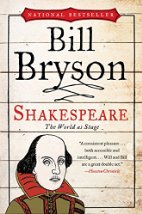
Shakespeare: The World as Stage by Bill Bryson


The argument over the author of Shakespeare’s plays – and even his existence – rely on a rather silly and unsupported raft of ideas, which easily sink on close examination.  The documents mentioning Shakespeare are legion, yet not a single document directly connecting another author to the plays exists.  Many of the candidates died before Shakespeare, and plays those candidates supposedly penned, contained events of ideas which occurred after their death.  Bill Bryson has authored an entertaining and carefully supported review of what we do know about the Bard of Avon.  His 2007 national bestseller, Shakespeare: The World as Stage, should be of interest to anyone even remotely curious about the greatest writer in the English language.

Bill Bryson has written a number of non-fiction works, which have occupied the best seller lists for some time.  He was born in Des Moines, Iowa, but now lives in Norfolk, England.  His smooth and entertaining style is accessible to anyone with even the slightest idea of Shakespeare from high school English classes.  Bryson also provides vivid pictures of Elizabethan England.  He writes of London, “City life had a density and coziness that we can scarcely imagine now.  Aware from the few main thoroughfares, streets were much narrower than they are now, and houses, with their projecting upper floors, often all but touched.  So neighbors were close indeed, and all the stench and effluvia that they produced tended to accumulate and linger.  Refuse was a perennial problem. […] Rich and poor lived far more side by side than now.  The playwright Robert Greene died in wretched squalor in a tenement in Dowgate, near London Bridge, only a few doors from the home of Sir Francis Drake, one of the wealthiest men in the land” (49).  Bryson continues, “According to nearly all histories, the gates to the city were locked at dusk, and no one was allowed in or out till dawn. though as dusk falls at midafternoon in a London winter there must have been some discretion in the law’s application or there would have been, at the very least, crowds of stranded, and presumably aggrieved, play goers on most days of the week” (49-50).

The book also contains a number of interesting tidbits about the times.  Of particular interest to me is the state of publishing and book binding.  Bryson writes, “Printed books had already existed, as luxuries, for a century, but this was the age in which they first became accessible to anyone with a little spare income.  At last average people could acquire learning and sophistication on demand.  More than 7,000 ttiles were published during Elizabeth’s reign – a bounty of raw materials waiting to be absorbed, reworked, or otherwise exploited by a generation of playwrights experimenting with new ways of entertaining the public.  This is the world into which Shakespeare strode, primed and gifted” (52).  So much for the naysayers idea that a country boy, who did not have a college degree, could have written so many memorable and magnificent works.

In 1668, John Dryden wrote of Shakespeare, “Those who accuse him to have wanted learning, give him the greater commendation: he was naturally learn’d” (109)

Bill Bryson’s entertaining and enlightening book, Shakespeare: The World as Stage also has an extensive bibliography for further reading.  I would also recommend Stephen Greenblatt’s Will in the World for a further and more detailed exploration of Shakespeare’s life.  5 stars

--Chiron, 11/29/15

Tuesday, June 02, 2015

So It Goes, Kurt Vonnegut: A Life by Charles J. Shields


Back in the 60s, everyone read Kurt Vonnegut – for his humor, his satire, his snarky comments, and his off-beat and quirky style.  I tried Cat’s Cradle and Slaughterhouse 5.  I rated both “Meh!”  Recently I came across some of his later works, and I went back and re-read the two early novels.  While I didn’t really enjoy, the novels, I was curious about them.  Then, along comes a new biography of Vonnegut, And So It Goes, by Charles J. Shields.  Now I have a much better understanding of Vonnegut and a greater appreciation for his work.

Shields authored Mockingbird, a best-selling biography of Harper Lee.  A former teacher, Shields has served as a reporter for NPR, a journalist, and the author of several non-fiction books for children.  His biography of Vonnegut, is detailed, well-documented, and illustrated with several photos of important people and moments in the life of the quirky author.

Kurt Vonnegut had a difficult life.  He constantly found himself in the shadow of his older brother, Bernard, who informed the young Kurt he was “an accident.”  He also had a difficult relationship with his father.  Added to that was a rocky marriage complicated by the arrival several nieces and nephews orphaned by a train wreck (their father) and the death of Alice (their mother) of cancer a few days later.

At a party, Kurt sat down to play the piano.  Two women joined him, and the bench collapsed.  Shield’s writes, “Beneath the hilarity, though, several women got the impression that [Kurt’s wife] Jane, pregnant, already had two children on her hands: three-year-old Mark and her husband.  ‘Being Mrs. Vonnegut,” said one of her friends, ‘was not a nine-to-five-job because he was not inclined to do things for himself.’  When attention strayed from Kurt, she tried to direct it back to him.  He didn’t deem like the typical father, either, at least to another dad at the party – rather distant, in fact.  When Mark [Kurt’s son] rode his tricycle into the room, Kurt said quietly, ‘Mark, that’s gauche,’ and let it go at that.  Nevertheless, Jane whisked around the party, floating on happiness. // Two months later, on December 29, their second child Edith was born.”  (110).

Vonnegut also had a peculiar relationship with his wife.  Kurt wanted to move to Cape Cod where he could befriend other writers, and have the peace and solitude he needed to write.  Shields explains, “From now on, they would live for the arts.  They would read the best and latest books, discuss them, make notes to each other in the margins, and give full rein to Kurt’s career in a location that couldn’t be more salubrious for creativity.  They must do it – to be true to themselves.  And for Kurt it was the vicarious realization of his mother’s dream to live and write on Cape Cod’ (118).  Vonnegut also agonized over the suicide of his mother.  This tragedy, together with his knotty relationships and his World War II experiences as a P.O.W. in Dresden during the horrific firebombing by British and American air forces, shaped his personality and informed his style. 

Kurt Vonnegut is an important figure in post-war fiction.  Charles J. Shields’ biography, And So It Goes, Kurt Vonnegut: A Life sheds a brilliant light on this quirky writer.  It also led me to a better understanding of his fiction.  5 stars.

--Chiron, 6/2/15


Friday, March 07, 2014

The Queen's Bed: An Intimate History of Elizabeth's Court by Anna Whitelock


I have frequently written about my fondness for the Tudor Dynasty, which lasted from 1485 to 1603.  The period featured scads of colorful and interesting characters, drama, espionage, treachery, love, hate, corruption, and nearly any other positive or negative activity from tennis to mass executions one can imagine.   

Anna Whitelock’s recently published volume, The Queen’s Bed: An Intimate History of Elizabeth [I]’s Court peers into the most closely guarded secrets of the Court of the Virgin Queen.  These secrets involve the women closest to her.  This platoon of servants were with her from dawn to dusk; from the moment she opened her eyes in the morning through her several-hour ordeal of dressing, primping, and applying makeup, until she is disassembled and readied for a night’s sleep.  The most favored women share her bed chamber through the night, and sometimes even her bed.

Elizabeth I
Rumors of scandals quickly began swirling around Elizabeth almost from the moment she received the crown of England.  The rumors largely revolved around her single status.  Whitelock’s meticulously researched and documented work stuns the reader with its depth and breadth of detail.  Eight pages of color pictures – including well-known portraits of Elizabeth and those of her Ladies-in-Waiting and Maids of the Chamber -- are a treasure trove of insights into one of the most powerful women in history. 

Among a series of epigrams, Whitelock quotes the queen, “We princes, I tell you, are set on stages in the sight and view of all the world duly observed; the eyes of many behold our actions, a spot is soon spied in our garments; a blemish noted quickly in our doings.”  This was in the days long before cameras, paparazzi, and gossip columns. 

Anna Whitelock

Whitelock writes, “The Queen’s Bedchamber was at once a private and public space.  The Queen’s body was more than its fleshly parts; her body natural represented the body politic, the very state itself.  The health and sanctity of Elizabeth’s body determined the strength and stability of the realm” (8).  As pressure grew on England from without – the excommunication by the pope, plots by her cousin Mary, Queen of Scots, and Spanish supporters of Mary I, her deceased half-sister, and from within that she should marry and produce an heir, Elizabeth maintained her kingdom.  William Cecil, Lord Burghley, her most trusted advisor said, “The state of this crown depends only on the breath of one person, our sovereign lady.”

We also learn some astounding statistics.  “The court [included] more than a thousand servants and attendants, ranging from brewers and bakers, cooks, tailors and stable hands to courtiers and ambassadors” (17). Whitelock notes, when Elizabeth moved between her homes, three hundred carts of personal possessions moved with her (17).  146 yeoman of the Guard accompanied the queen wherever she happened to be (18).

Anna Whitelock’s, The Queen’s Bed, provides endless fascination for readers of history and biography of significant women on the world’s stage.  5 stars 

--Chiron, 3/4/14

Sunday, November 06, 2011

Catherine the Great: Portrait of a Woman by Robert K. Massie

Forty some years ago, as I gathered textbooks at LaSalle College for another semester pursing a degree in political science, I happened to pass a textbook for a class which not in my major. I grabbed a copy, and thus began a lifelong interest in the history of Russia. Robert K. Massie has written a definitive biography of Tsarina Catherine II, known as Catherine the Great.

Well-educated, multi-lingual, cultured, free-spirited, graceful, with a good measure of beauty and charm only begins to describe this complex, intelligent woman.

Catherine, a voracious reader of the great enlightenment thinkers such as Diderot, Montesquieu, Beccaria, and, perhaps most importantly, Voltaire, attempted a radical reform of the Russian legal and economic systems. She titled her document the Nakaz, or “Instruction.” She believed a benevolent autocracy was the only form of government able to hold together the vast Russian Empire with its mind-numbing variety of ethnic groups, languages, philosophies, religious views, and social classes.

The same men who profoundly influenced our founding fathers, instructed Catherine in equal rights for men and women, religious freedom, strict limits on capital punishment, and the banning of torture. Unfortunately, the serfs, considered property tied to the land, would only receive limited benefits from this proposal. When the nobles finished hacking and sawing the 500 plus articles in her manifesto, barely a quarter of her two-year’s labor remained. Yet Voltaire hailed it as masterpiece of Enlightenment thought and practice.

I was particularly struck by some ideas and quotes of Voltaire’s incorporated into the Nakaz. For example, Catherine wrote, “Experience shows that the frequent use of severe punishment has never rendered a people better. The death of a criminal is a less effective means of restraining crimes than the permanent example of a man deprived of his liberty during the whole of his life to make amends for the injury he has done to the public” (350). This sentence is worthy of Jefferson, Washington, Adams, or Lincoln.

In prohibiting censorship and promoting free speech, she wrote, “censorship can be ‘productive of nothing but ignorance and must cramp the rising efforts of genius and destroy the very will for writing” (351).

When Catherine ascended the throne in 1761, she immediately put an end to a pointless, costly, and destructive war in Eastern Europe. She believed, as Voltaire wrote, “The victorious nation never profits from the spoils of the conquered; it pays for everything. It suffers as much when its armies are successful as when they are defeated. Whoever wins, humanity loses” (335).

This meticulously documented biography covers Catherine’s life from her birth as Sophia in 1727 through her 34-year reign as Empress Catherine II to her death in 1796.

The only shortcoming – and a minor one at that – is the lack of genealogical chart to separate all the Catherines, Peters, Pauls, and Ivans which populated the Russian Empire during the enlightenment. Due for publication November 8th, be sure to add this fascinating biography to your TBR list. 5 stars.

--Chiron, 10/27/11

Sunday, December 12, 2010

Cleopatra: A Life by Stacy Schiff

Cleopatra is arguably, as Stacy Schiff stated in a recent interview, the most famous woman we know so little about. I would add the most famous woman about whom so many myths and misperceptions swirl about her. Schiff has set down a detailed biography drawn from contemporary sources, including Plutarch, Dio, and Josephus. She carefully points out inconsistencies in these accounts, and deftly explains the political and social reasons her history appears as it does today.

Schiff disposes of several myths. She was not Egyptian, or even African – she was Greek through and through. She was not beautiful. Some Romans chided Julius Caesar for his liaison with her, because, “she’s not even beautiful. Lastly, she did not take her life by the bite of an asp. Alexandria held a reputation as a center for the finest poisons in the known world. Their potions acted quickly, irreversibly, and with no pain.

The Romans – great admirers and imitators of the Greeks – seem to have taken a cue from Euripides, who wrote, “Clever woman were dangerous” (qtd. in Schiff 4). She had an impressive education – the finest anyone could receive at the time. She spoke nine languages, and routinely negotiated difficult agreements and treaties with foreign kings without the aid of an interpreter. Even her contemporary critics “gave her high marks for her verbal dexterity. Her ‘sparkling eyes’ are never mentioned without equal tribute to her eloquence and charisma” (33).

The Romans treated their women as little more than personal objects to be bought, sold, traded, or discarded on the slightest whim. Cleopatra’s world, however, provided an environment in which women thrived socially, politically, financially, and educationally. According to Schiff, “as much as one-third of Ptolemaic Egypt may have been in female hands” (24). After her death, “a golden age of women dawned in Rome” (295). Suddenly, they enjoyed unprecedented freedom and political power.

The Romans respected Cleopatra, after all her fields and stores of grain fed the Roman Empire. But they also feared her wealth and her position as a queen with unparalleled support of her people. During her 22 year reign, not a single revolt or attempt on her life ever occurred. Rough estimates of her personal fortune place her among the wealthiest people of all time – over $100 billion dollars in today’s money. Kings would routinely give her a gift of thousands of silver talents, when 220 of the coins could feed and equip a Roman Legion for a year. Favored Court officials might be paid a single talent a year and believe themselves well-compensated. Yet her generosity with her people and her guests was legendary at the time.

Near the end. Schiff writes, “In the match between the lady and the legend there is no contest.

The personal inevitably trumps the political, and the erotic trumps all: We will remember that Cleopatra slept with Julius Caesar and Mark Antony long after we have forgotten what she accomplished in doing so, that she sustained a vast, rich, densely populated empire in its troubled twilight, in the name of a proud and cultivated dynasty. She remains on the map for having seduced two of the greatest men of her time, while her crime was to have entered into those same ‘wily and suspicious’ marital partnerships that every man in power enjoyed.” (299)

The only problem I had with the text came in the lack of connection to quotes and over 40 pages of notes. She opts for endnotes marked only by the page they reference. However, the notes have a detail, and at times a touch of humor, absent in such a vast undertaking. Schiff tells the true story of one of the great love stories of all times. She cites dozens of versions of her story, including Shakespeare’s, perhaps his greatest love story. Even if a reader’s grasp of Roman and Ptolemaic history resides in a dim college classroom, this biography will enthrall and amaze. The slight inconvenience in searching out and reading notes is well more than worth the effort to shine a brilliant light on those memories. 5 stars.

--Chiron, 12/12/10

Friday, May 28, 2010

Thomas Jefferson: Author of America by Christopher Hitchens

This slim and interesting volume has Hitchens’ peculiar voice with occasional strident undertones leaking through. I don’t mind, because he is one of the best writers around today who criticizes the religious excesses our country founders in at this point in history. While most of the biography had a dry tone, the first chapter dealing with religion had the most meat for me. Four stars.

--Chiron, 5/28/2010

Monday, September 21, 2009

Cheever: A Life by Blake Bailey

Admirers and students of John Cheever’s fiction will find this biography engrossing, thoughtfully detailed, and sprinkled throughout with wonderful quotes from his family, friends, editors, peers, and even former teachers. For those not familiar with his novels and spectacular short stories, it may seem to plod and drag in spots. I have admired Cheever for over 35 years, and actually met him at his home in Ossining, NY. I wrote the following profile of John Cheever last year. I believe it tells much about the man and the writer.

The first obituary appeared in the June 19, 1982 edition of The Philadelphia Inquirer. The shock prevented me from reading it carefully, but one sentence leaped from the page: “Mr. Cheever called confinement ‘one of the principal themes of my work’.” That sentence percolated through my memories of our meeting and all his books I had read.

Several letters in 1978 and 1979 finally resulted in a meeting one chilly November day in 1979. John was dressed as if he were about to sit for another dust jacket photo – slacks, white button-down shirt, no tie, and bedroom slippers.

His desk was an ordinary dining room table and the room held floor to ceiling shelves overflowing with books in every possible space. They spread across the floor like a paper glacier. There wasn’t any wall space, but he did have several pictures hanging from shelves, which seemed as haphazard as the books on the floor.

According to the obit, John believed, that “discovering the liberties one can enjoy within the confinement of one’s own mortality is basically the nature of life on this planet.” His room was confining in a physical sense, but the pathways through books gave him the freedom to explore the universe.

John asked his wife for some tea, as he bulldozed the clutter to one side clearing room for a stack of treasures. As he sat in a rattan chair, he reached back into the clutter for a pen and tried several before he found one that wasn’t dry. “I have a thousand pens here, but not one in ten works.”

The cigarette that he lit in his frustration was a distant descendent of the one that got him expelled from Thayer Academy and provided the inspiration for his first published short story, “Expelled,” which appeared in The Nation magazine, which rarely, if ever, published fiction.

A golden retriever padded in slowly and put his head on John’s lap for the gentle stroking he expected and received. Just then, an obviously jealous cat jumped up into his lap and purred loud enough to drown the scratching of his pen.

John signed the books and talked about his fiction. The steam from the tea rose like the remnants of fog on the Hudson River just outside his window. The conversation wandered through Bullet Park, among the Wapshot family, and stopped at “The Enormous Radio,” a popular Cheever story.

His mind traveled over a landscape dotted with his characters’ families, their heartbreak and happiness. He remembered them all – treasures of his life, fondly recalled.

Clearly there was actual confinement in his life. His daughter, in an interview with The Philadelphia Inquirer on the publication of her biography of her father, Home Before Dark, published two years after his death, told of his “confinement” by alcoholism, bisexuality, and depression. Perhaps his novels and stories were a means to manage the imprisonment of “the nature of life on this planet.”*

The interview over, I sadly gathered the books. I wanted to stay and listen to this charismatic writer for hours, but I had intruded enough. As I walked down the driveway to my car, I turned and saw him waving one last time.

*Interview with Susan Cheever. The Philadelphia Inquirer. 2 Dec. 1984: 11K.

For those without a unique personal experience like this, the book will fill out the nooks and crannies of a man who lived a difficult life, yet added so much pleasure to so many of his readers around the world.

--Chiron, 9/30/09

Monday, April 20, 2009

Unpacking the Boxes: A Memoir of a Life in Poetry by Donald Hall


Donald Hall delivered the keynote lecturer at the annual Beall Poetry festival at Baylor University this year. I purchased this book and a collection of his poems, which he graciously inscribed to me.

Over the years, I have run into an occasional poem by Hall, but never read him extensively. His lecture had humor and a certain earthiness to it, but I had a hard time understanding chunks of his talk – the sound system failed time and again.

The initial chapters related his childhood and his early desire to become a poet. the story followed him through high school and college to post-graduate studies in England. He related details of his life as he began teaching and finally reached a point in his career where he could devote himself to writing full-time.

Unfortunately, the last three chapters dwell on his wife’s battle with cancer, and his decline, culminating in a stroke a few years ago. He recovered and returned to his desk to finish this book.

These last chapters turned the whole tone of the book around, and it ended on a sour note. Still an interesting life, and I am glad I met him. I look forward to reading the collection of poems. 4 stars

--Chiron, 4/20/09

Thursday, March 12, 2009

Rocket Boys by Homer H. Hickam, Jr.


This rather juvenile autobiography of a group of boys in a West Virginia coal mining town tells the story of their fascination with space in the days of Sputnik. One Book, One Waco picked this story for its spring 2009 read.

I enjoy literary and historical biographies when they relate to literature, for example Iris, the recent outstanding biography by Peter Conradi and Juliet Barker’s bio of Henry V and the Battle of Agincourt. But teen bios are not my thing. This story is amusing – to 14-year olds -- but not to me. I have an obligation to read it, but I would gladly invoke the rule of 50 here. Furthermore, I do not enjoy “fictionalized” biography.

To begin with the book has about 100 or more pages than necessary. All the stuff about unionizing mines and “Sonny’s” older brother’s football problems lack relevance to the rest of the story. Two pages on Homer getting a new kitten, pages and pages about the culture of football and how the players dated all the cute girls and ruled the school likewise detracted from the story of the rockets. A tighter focus on the rockets would have pleased me more.

Admittedly, the book is well written, and an interesting story. The final chapters on the last rocket designs, the boys learning calculus, and the science fair experiences are first rate. Had the entire book focused on the rocket boys, I would have enjoyed it a lot more. 3 stars

--Chiron, 3/12/09

Tuesday, March 10, 2009

Byron in Love by Edna O'Brien

Lady Caroline Lamb wrote in her journal that Byron was, “mad, bad, and dangerous to know.” I tried to use a gentler variation of this line in my younger days when a woman began making matrimonial sounds. However, I had no idea exactly how bad, how mad, and how dangerous Byron was!

The generally reliable O’Brien has spun an absorbing tale of a man who literally had to drive women away from him with insults, protestations that he loved someone else, and transcripts of love letters he received from other women.

O’Brien’s occasionally witty narrative has a lot of interesting information. Unfortunately this “uncorrected proof” has errors typical of galleys, so I plan on getting a copy when Norton publishes it in June. O’Brien’s prose enchants on every page, it flows with the lyricism characteristic of her fiction. Even a reader not a fan of the Romantic poets, who knows little of Byron but cares about poetry, literature, and the psyche of a writer, must place this slim volume high up on a list of books “to be read.”

My biggest criticism concerns the lack of attributions to quoted material. Not even a bibliography appears at the end. Four stars because of this minor lapse.

I think I will read more of her novels and her biography of James Joyce.

--Chiron, 3/10/09

Thursday, February 26, 2009

Mockingbird: A Portrait of Harper Lee by Charles J. Shields

This volume, billed as a “portrait” of Nelle Harper Lee, disappointed me a bit. Shields primarily writes young adult non-fiction, and although the jacket claims he was trying to write an adult book, I fear he has fallen a bit short.

The story is quite repetitive, and the tone definitely favors teen readers. In addition, I noticed a few grammatical and spelling errors. A couple of sentences really required me to pause and dissect them before proceeding.

Another problem with the book involves a chapter and another long section which focuses more on Truman Capote and the writing of In Cold Blood than on Lee and To Kill A Mockingbird. In fact, the best chapter deals with Lee’s experiences in New York surrounding the writing and publication of her novel. Unfortunately, the next chapter rather boringly surveys the critical reviews of TKAM.

All in all, I have to classify this as a mildly interesting, so-so read. 3 stars.

--Chiron, 2/26/09

Friday, January 09, 2009

The Defining Moment by Jonathan Alter

This story of the election of Franklin Delano Roosevelt and his first hundred days in office beginning in March 1933 seems more than appropriate as an historic inauguration occurs in about ten days.

Many pundits have compared Obama to Lincoln, but Alter draws many more parallels to FDR. First of all, he succeeded an unpopular president as the country was on the edge of a serious downturn, which would come to be known as “The Great Depression.” FDR was unlike any previous president in many ways. Some called him a traitor to his class because of all the social programs he started.

Hoover raised taxes and cut spending, which helped propel the nation deeper into the economic morass. FDR brought a message of hope and change to desperately poor and hungry people. He was also the first to address the nation in a casual, conversational manner in his “Fireside Chats” beginning almost immediately after his inauguration. The text of that chat, as well as his first inaugural address, are in appendices. The often quoted line, “the only thing we have nothing to fear, is fear itself – nameless, unreasoning, unjustified terror which paralyses needed efforts to convert retreat into advance” (339). Considering the fear we have lived under for the last eight years, I can only hope the Obama administration will have the same attitude.

Also like Obama, FDR was “always willing to listen to someone smarter than he was tell him why his ideas were no good” (249). A president that does not hide his opinions and policies decisions will be a breath of fresh air after the smog of Bush 43. FDR also said, “It is common sense to take a method and try it: if it fails, admit it frankly and try another. But above all, try something” (92-93). Refreshing when compared to a president unable to think of any mistakes, and who counts his greatest achievement as a failed attempt to privatize Social Security!

Alter’s style is smooth and eminently readable. His extensive quotes really bring FDR to life. One of my favorites is “Happiness lies not in the mere possession of money; it lies in the joy of achievement” (219).

FDR was the first to travel extensively by plane. Maybe Obama’s Blackberry is a close analogy.

Anyone who thinks the current economic crises is bad, should read this book and get a glimpse of what life was like in the US during the Depression. Today’s crisis doesn’t seem quite so bad, and not quite so hard to fix. Five stars.

--Chiron, 1/19/08